


SURGERY ON THE THYROID GLAND
The thyroid gland can develop benign or malignant diseases.
When we talk about benign diseases, we can include hyperthyroidism (increased thyroid function), goiter (enlargement), and nodular thyroid disease.
Malignant diseases include, for example, well-differentiated carcinomas and medullary thyroid carcinoma, which manifest as nodules in the thyroid or neck.
Although the thyroid can cause a variety of symptoms (weight loss or gain, difficulty swallowing, hoarseness, insomnia, among others), the vast majority of thyroid nodules do not cause symptoms. In their evaluation, it becomes essential to understand whether these may or may not be associated with thyroid disease. Thus, a proper clinical investigation is of utmost importance, especially when surgical indication exists.
Thyroid gland surgery is called thyroidectomy and can consist of total removal (total thyroidectomy) or partial removal of the gland (hemithyroidectomy) and is indicated in the following cases:
- Biopsy with a result of cancer or suspicious for cancer;
- Inconclusive biopsy;
- Nodules larger than 4 cm;
- Goiter or very large thyroid compressing structures or extending into the chest;
- Uncontrolled hyperthyroidism.
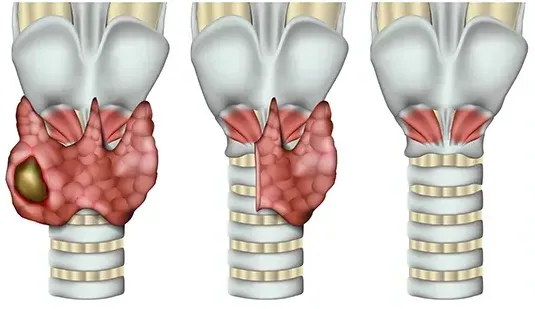
Before undergoing thyroid gland surgery, several tests should be carried out, namely:
- Blood tests for thyroid function (T4, TSH);
- Laryngoscopy by an otolaryngologist to assess the function of the vocal cords, as the nerves that innervate the vocal cords are located near the gland;
- Ultrasound of the gland: the presence of microcalcifications, hypoechoic solid nodules, hypervascularization, and the presence of irregular borders are considered suspicious for malignancy;
- Ultrasound-guided fine-needle aspiration cytology (a needle biopsy for cell collection);
- CT scan to assess the extent of the disease below the sternum and whether there is any compression of the trachea.
Possible complications of thyroid surgery are often not clearly explained to patients, and it is still very common to see patients who become hoarse after surgery and consider this to be normal and expected. In reality,
it is not normal! It is a surgical complication that should be avoided, but most importantly, it can be treated. Voice or breathing rehabilitation is possible through surgery to recover the nerves of the vocal cords or reinervation, or even through other interventions such as injections into the vocal cords or the placement of prostheses.
